Magento Cloudflare Admin Panel Image Upload Issue

File upload is an essential aspect of any project. Given this importance, information technology is surprising that many developers confront challenges of adding file upload feature to their projects. In particular, developers are unsure about how to upload and validate files.
In this tutorial, I will discuss how to implement Laravel file upload functionality with multiple file and prototype uploading selection. I will utilize the Laravel storage folder and then create database tape for uploading files. I will use Laravel 5.five and Bootstrap to power the code of this tutorial.
- Prerequisites
- Create Model with Migration
- Item Model
- Create the Migration
- Model Of ItemDetails
- Migration of ItemDetails Table
- Database Configuration
- Prepare the Route
- Create the Controller
- View File (Upload_form.blade.php)
- Controller with Validation
- Storing Information and Files in Laravel
- With Validation
- Deviation Betwixt Local and Public Disks
- Manipulating files
- Sending Files every bit Email Attachments
- Create email sender class
- Create the email template
Yous might also like: PHP File Upload with jQuery AJAX
Prerequisites
For the purpose of this tutorial, I assume that you have a Laravel awarding installed on a web server. My setup is:
- Linux/Unix or WAMP/XAMPP surroundings
- Laravel 5.5
- PHP 7.1
- MySQL
- Spider web server (Apache, NGINX or integrated PHP web server for testing)
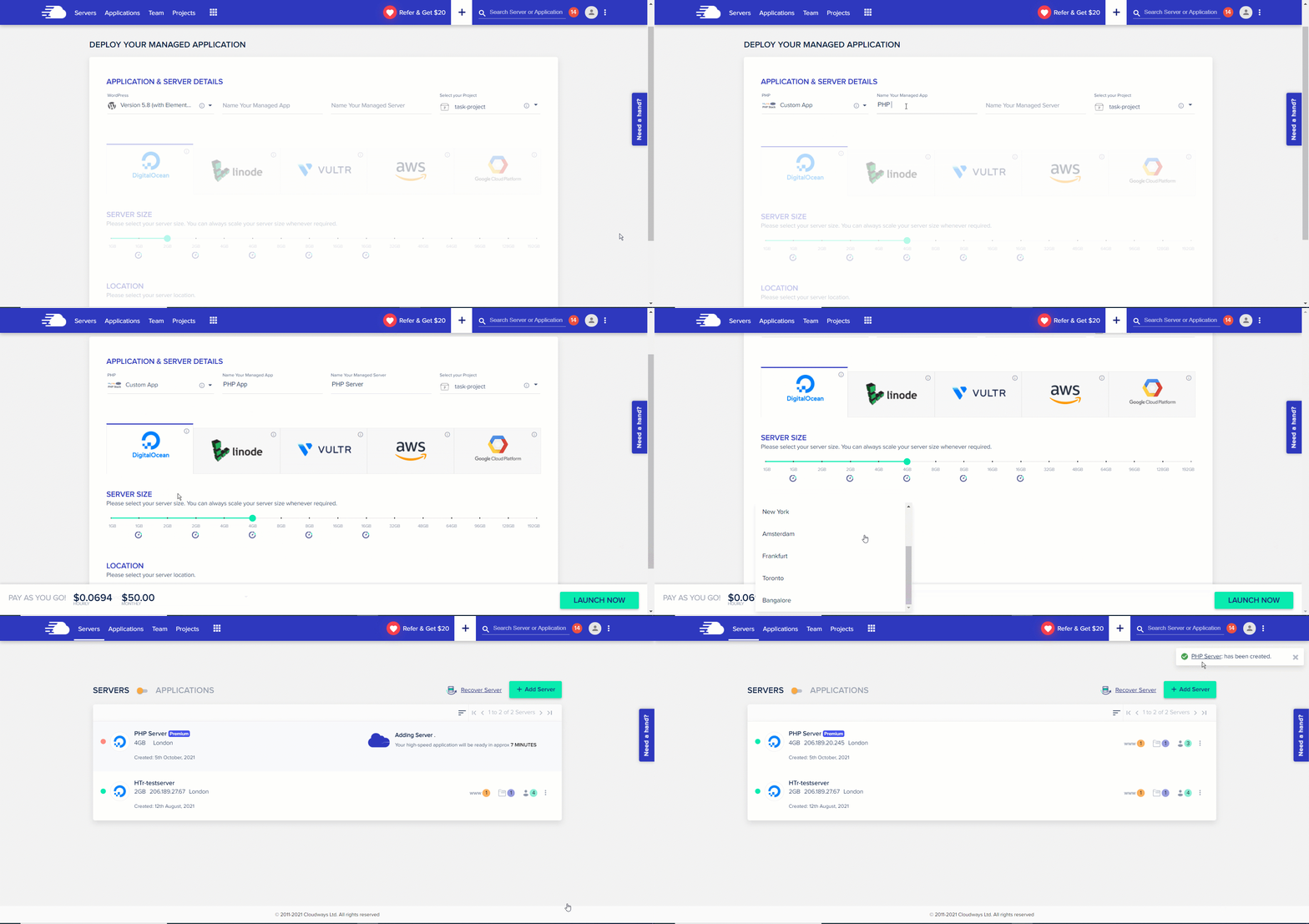
I have installed a Laravel app on a Cloudways managed Laravel server considering it has everything I'll need for this tutorial. If you do non have an account on Cloudways, sign up for costless, and bank check out the post-obit GIF to setup the server and application in just a few clicks.
Create Model with Migration
I will start by creating the model and the tables in which I volition salvage the files.
Launch the SSH last, get to the application'due south public root binder and type following commands:
php artisan brand:model Item -m php artisan make:model ItemDetails -m
Detail Model
When the migration and the model have been created successfully, go to app/Detail.php and add together the following Model lawmaking to it:
<?php namespace App; utilize Illuminate\Database\Eloquent\Model; class Item extends Model { protected $fillable = ['name']; } Create the Migration
Become to the database/migration folder and open the migration file for item. Y'all volition come across the default structure that include (in my example) id , name, timestamps.
<?php use Illuminate\Support\Facades\Schema; use Illuminate\Database\Schema\Pattern; apply Illuminate\Database\Migrations\Migration; class CreateItemsTable extends Migration { public function upwards() { Schema::create('items', function (Blueprint $table) { $table->increments('id'); $table->string('name'); $table->timestamps(); }); } public function down() { Schema::drop('items'); } }?> Model Of ItemDetails
The model comprises of the following code:
<?php namespace App; use Illuminate\Database\Eloquent\Model; class ItemDetail extends Model { protected $fillable = ['item_id', 'filename']; public office detail() { return $this->belongsTo('App\Detail'); } } ?> In the in a higher place lawmaking, I used belongTO because itemDetails belongs to Item table and item_id is the foreign key. This is known as inverse relation in Laravel.
Migration of ItemDetails Table
Go to the database/migration binder and open the migration file for itemdetails. Yous will see the default structure that include id , proper noun . timestamps.
<?php use Illuminate\Support\Facades\Schema; use Illuminate\Database\Schema\Blueprint; apply Illuminate\Database\Migrations\Migration; form CreateItemDetailsTable extends Migration { /** * Run the migrations. * * @render void */ public function up() { Schema::create('item_details', part (Blueprint $table) { $tabular array->increments('id'); $table->integer('item_id')->unsigned(); $tabular array->foreign('item_id')->references('id')->on('items'); $table->string('filename'); $table->timestamps(); }); } public function down() { Schema::drop('item_details'); } } ?> Next , In the app/Providers/AppServiceProvider.php file, the kicking method set a default string length:
employ Illuminate\Support\Facades\Schema; public function boot() { Schema::defaultStringLength(191); } Database Configuration
In a Laravel powered app, database configuration is handled by two files: env and config/database.php. In my case, I created a database with the name uploading. The Cloudways Database Manager makes the unabridged process very like shooting fish in a barrel.
Next, run the following control in the terminal to create tables in the database:
php artisan migrate
Now, when you lot check the database, y'all will see that the tables have been created successfully.
You lot might as well like: Connect Laravel with Firebase Real Time Database
Set up the Route
Route sets the application URL and the controller method for this URL. Routes are located in road/spider web.php and contains the post-obit code:
Route::get('/multiuploads', '[e-mail protected]'); Route::post('/multiuploads', '[email protected]'); Cease Wasting Time on Servers
Cloudways handle server direction for you lot so you can focus on creating groovy apps and keeping your clients happy.
Create the Controller
Next, create the Controller by using the following command:
php artisan make:controller UploadController
Side by side, go to app/Http/Controller/UploadController and open up the Controller file. Add the following code to information technology:
namespace App\Http\Controllers; utilize Illuminate\Http\Request; course UploadController extends Controller { public role uploadForm() { return view('upload_form'); } public function uploadSubmit(Asking $request) { // coding …. } } View File (Upload_form.blade.php)
In the view file, I take used Bootstrap for styling the code, link stylesheet , jQuery, JavaScript files.
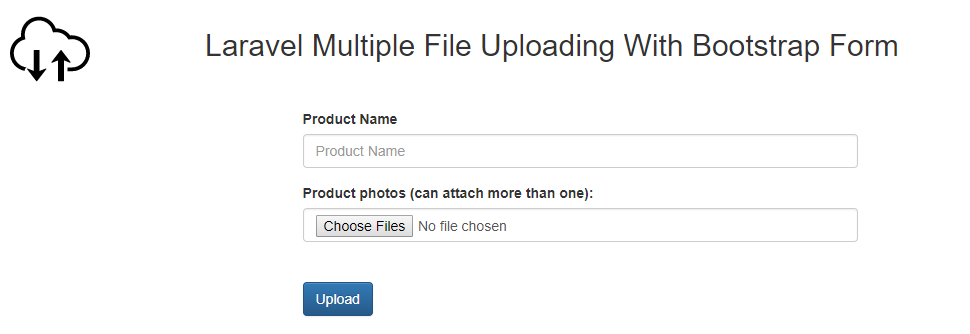
<!doctype html> <html lang="{{ app()->getLocale() }}"> <head> <meta charset="utf-8"> <meta http-equiv="X-UA-Compatible" content="IE=edge"> <meta name="viewport" content="width=device-width, initial-scale=1"> <title>Laravel Uploading</title> <link rel="stylesheet" href="https://maxcdn.bootstrapcdn.com/bootstrap/3.iii.vii/css/bootstrap.min.css" integrity="sha384-BVYiiSIFeK1dGmJRAkycuHAHRg32OmUcww7on3RYdg4Va+PmSTsz/K68vbdEjh4u" crossorigin="anonymous"> <!-- Optional theme --> <link rel="stylesheet" href="https://maxcdn.bootstrapcdn.com/bootstrap/iii.3.7/css/bootstrap-theme.min.css" integrity="sha384-rHyoN1iRsVXV4nD0JutlnGaslCJuC7uwjduW9SVrLvRYooPp2bWYgmgJQIXwl/Sp" crossorigin="bearding"> <!-- Fonts --> <link href="https://fonts.googleapis.com/css?family=Raleway:100,600" rel="stylesheet" type="text/css"> <!-- Styles --> <manner> .container { margin-meridian:2%; } </mode> </head> <torso> @if (count($errors) > 0) <div class="alarm alert-danger"> <ul> @foreach ($errors->all() as $error) <li>{{ $mistake }}</li> @endforeach </ul> </div> @endif <div course="container"> <div grade="row"> <div class="col-dr.-2"> <img src="/32114.svg" width="80" /></div> <div class="col-dr.-8"><h2>Laravel Multiple File Uploading With Bootstrap Form</h2> </div> </div> <br> <div class="row"> <div class="col-md-three"></div> <div course="col-md-6"> <course activeness="/multiuploads" method="post" enctype="multipart/course-data"> {{ csrf_field() }} <div class="form-grouping"> <label for="Production Name">Product Name</characterization> <input type="text" proper name="name" course="grade-control" placeholder="Product Proper name" > </div> <label for="Production Name">Product photos (tin adhere more than than one):</label> <br /> <input blazon="file" class="grade-command" name="photos[]" multiple /> <br /><br /> <input blazon="submit" form="btn btn-primary" value="Upload" /> </class> </div> </div> </div> </trunk> </html> Controller with Validation
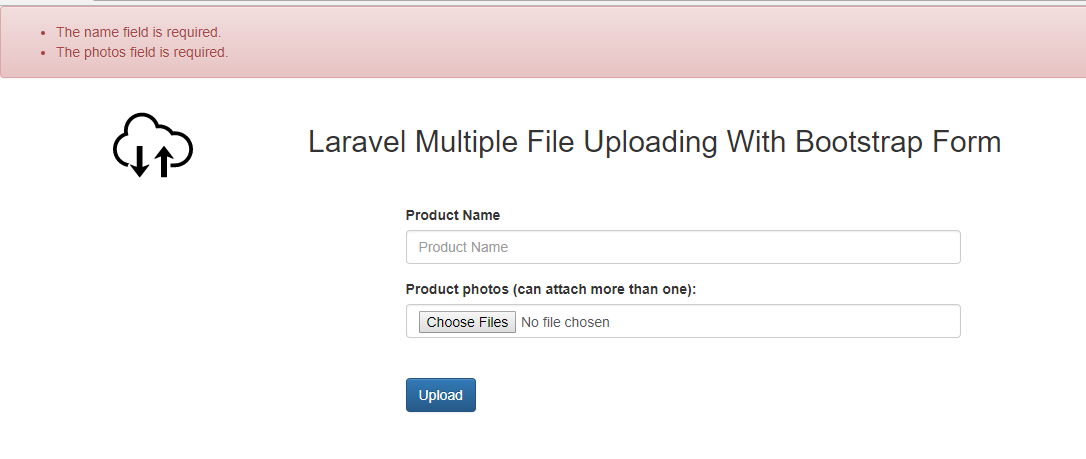
I have use Bootstrap classes for showing the alarm for validation and use Laravel Validation methods to validate the type of file. Use the post-obit code for the controller:
<?php namespace App\Http\Controllers; use App\Item; use App\ItemDetail; use Illuminate\Http\Request; form UploadController extends Controller { public function uploadForm() { return view('upload_form'); } public part uploadSubmit(Request $asking) { $this->validate($request, [ 'name' => 'required', 'photos'=>'required', ]); if($request->hasFile('photos')) { $allowedfileExtension=['pdf','jpg','png','docx']; $files = $asking->file('photos'); foreach($files every bit $file){ $filename = $file->getClientOriginalName(); $extension = $file->getClientOriginalExtension(); $cheque=in_array($extension,$allowedfileExtension); //dd($check); if($check) { $items= Item::create($request->all()); foreach ($request->photos equally $photo) { $filename = $photo->store('photos'); ItemDetail::create([ 'item_id' => $items->id, 'filename' => $filename ]); } echo "Upload Successfully"; } else { repeat '<div class="warning alarm-warning"><stiff>Alert!</stiff> Sad Only Upload png , jpg , doc</div>'; } } } } }?> Storing Data and Files in Laravel
Laravel provides a storage filesystem that stores all the data including files and images.
For this, Laravel provides config/filesystems.php, located in the config folder. In this file, yous can specify the locations for your file storage.
return [ 'default' => 'local', 'disks' => [ 'local' => [ 'driver' => 'local', 'root' => storage_path('app'), ], // ... Using the to a higher place code snippet, you could salvage the files in app/storage binder instead of the public folder. This is a good coding practice for storing data because this location is inaccessible from the browser. For the purpose of this tutorial, I have created a binder with the name photos in storage/app/.
When the run the app in the browser, you will see the post-obit screens:
With Validation
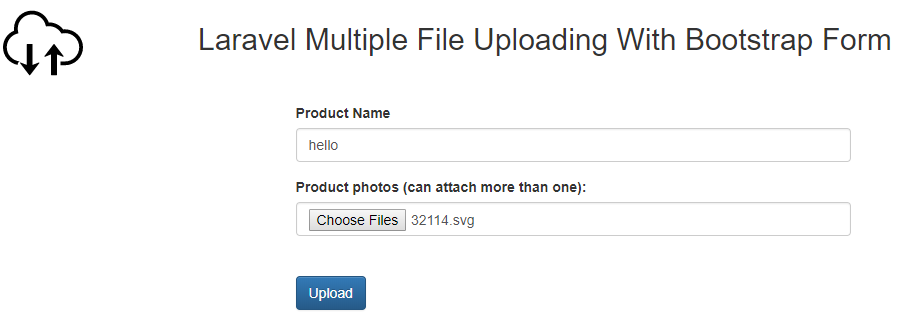
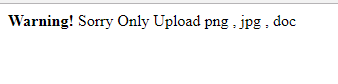
To meet the image and file upload in Laravel in activeness, check out the demo.
Difference Between Local and Public Disks
You can see the disks local and public divers in config/filesystems.php. Laravel uses the local disk configuration by default. The underlying difference between local and public disk is that local disk is private and can't exist accessed from the browser, whereas the public disk can exist hands accessed from the browser.
Since the public disk is in storage/app/public and Laravel's server root is in public, you need to link storage/app/public to Laravel's public binder. We tin can do by running php artisan storage:link.
Manipulating files
Laravel largely needs external assistance in resizing images, adding filters and other related operations. Adding these feature to the native surroundings of Laravel will only bloat the application since there isn't any installs needed. For that, we need a package chosen intervention/image. Earlier above, we have already installed this parcel, but yet composer requires information technology for reference.
We don't demand to register anything since Laravel can automatically detect packages. Read the following if you are using lesser version than Laravel 5.5.
To resize an prototype
$image = Image::brand(storage_path('app/public/profile.jpg'))->resize(300, 200); Fifty-fifty Laravel'southward packages are fluent.
Sending Files every bit Email Attachments
For transport files with attachments you simply paste the following code in your controller according to input fields.
<?php ... ... public part uploadDocument(Asking $request) { $title = $request->file('name'); // Get the uploades file with name document $document = $request->file('document'); // Required validation $asking->validate([ 'name' => 'required|max:255', 'certificate' => 'required' ]); // Cheque if uploaded file size was greater than // maximum immune file size if ($document->getError() == 1) { $max_size = $document->getMaxFileSize() / 1024 / 1024; // Become size in Mb $error = 'The document size must exist less than ' . $max_size . 'Mb.'; return redirect()->back()->with('flash_danger', $error); } $information = [ 'document' => $document ]; // If upload was successful // ship the electronic mail $to_email = [electronic mail protected]; \Mail::to($to_email)->send(new \App\Mail service\Upload($data)); render redirect()->back()->with('flash_success', 'Your document has been uploaded.'); } Create e-mail sender class
To send the electronic mail in Laravel, you need to create a separate class file. This class will have the functionality to prepare email and its body. Also we volition attach the uploaded file equally inline attachment.
Here is my email class:
<?php #App\Mail\Upload.php namespace App\Mail; utilize Illuminate\Motorcoach\Queueable; use Illuminate\Post\Mailable; use Illuminate\Queue\SerializesModels; class Upload extends Mailable { use Queueable, SerializesModels; protected $data; /** * Create a new message instance. * * @return void */ public function __construct($data=[]) { $this->data = $data; } /** * Build the bulletin. * * @return $this */ public function build() { render $this->view('emails/upload') ->subject field('Document Upload') ->attach($this->data['document']->getRealPath(), [ 'as' => $this->data['document']->getClientOriginalName(), 'mime' => $this->data['document']->getClientMimeType(), ]); } } The important functions used hither are:
– getRealPath(): Get the temporary upload path – getClientOriginalName(): Get the name of uploaded file – getClientMimeType(): Go the mime type of uploaded file
Create the email template
In the above step, our e-mail grade refers to the email template as return $this->view('emails/upload'). Then nosotros volition create the email template at resources/views/emails/upload.blade.php
#resources/views/emails/upload.blade.php <p>Hi,</p> <p>Please download the attached file.</p> <p>Thanks</p>
Now when you lot submit the course, your uploaded file volition be sent an email attachment.
Share your stance in the annotate section. Comment Now
Share This Article
Client Review at 
"Cloudways hosting has one of the all-time customer service and hosting speed"
Sanjit C [Website Programmer]

Pardeep Kumar
Pardeep is a PHP Customs Manager at Cloudways - A Managed PHP Hosting Platform. He love to work on Open source platform , Frameworks and working on new ideas. You tin email him at [email protected]
Source: https://www.cloudways.com/blog/laravel-multiple-files-images-upload/
0 Response to "Magento Cloudflare Admin Panel Image Upload Issue"
Post a Comment